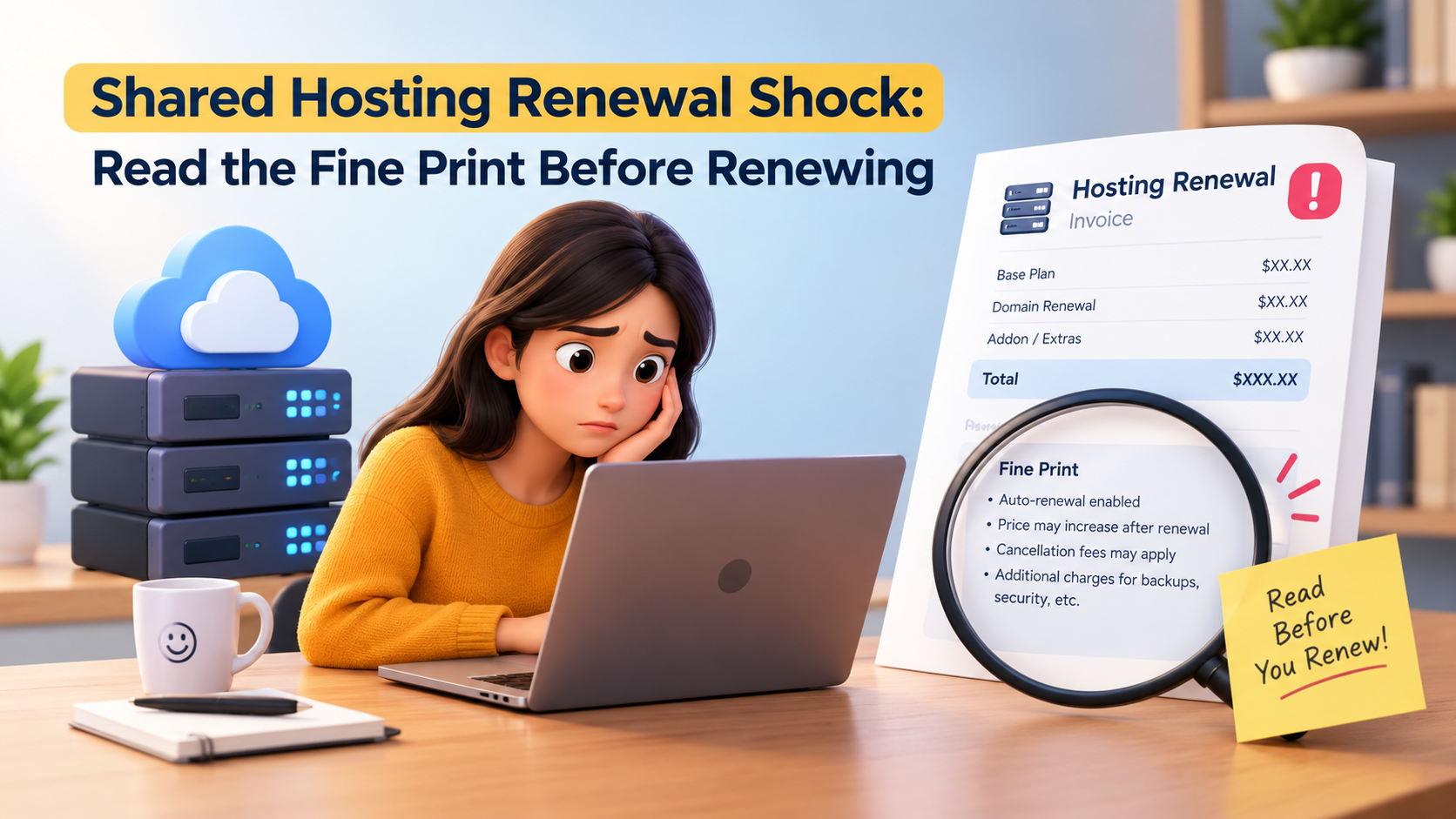
The email lands on a Tuesday. Your hosting is renewing next week, it says, and the amount is roughly three times what you paid last year. Same plan. Same server. Same you. That’s renewal shock, and it happens to more people every month than the industry likes to admit.
I’ve sold shared server hosting services for years, and I’ve also bought them from competitors to see how their pricing works. The pattern is familiar: a headline price grabs your attention, a long prepayment term sits beneath it, and the renewal rate hides in smaller text. You may only notice the difference when the next bill arrives.
The bill that arrives 12 months later
Here’s how it actually plays out. You pick a plan at $2.99 a month and pay upfront for one, two, or four years. After the site runs smoothly for months, you forget about it. When the term ends, the host charges the card on file at the standard rate, which was never the number you saw first.
The introductory price usually depends on the length of the initial term. A provider may advertise a low monthly figure, but you might need to pay several years in advance to qualify. Once that term ends, the provider can charge its standard renewal rate.
The renewal price matters just as much as the introductory offer. Before you sign up, check what the plan costs after the initial term and whether the provider applies the same price when you renew.
Why shared server hosting services are priced this way
Introductory pricing helps hosting companies attract new customers. Providers can offer lower prices for the first term and recover more revenue when customers renew.
For example, Hostinger Premium has advertised a $2.99 monthly price for a 48-month term. That works out to $143.52 upfront, compared with a stated regular price of $575.52. The plan renews at $10.99 per month, which is roughly 3.6 times the introductory monthly rate.
Bluehost Starter has also shown different renewal prices depending on the term: $15.99 monthly, $11.99 for a 12-month term, and $9.99 for a 36-month term.
These examples show why customers need to compare more than the headline price. What annoys me is the gap between the two numbers and how quietly hosts show it. A low introductory price can look attractive until you calculate what you will pay over several years.
What the 2026 numbers actually look like
The renewal multiplier
After checking the available figures, I found that the numbers contradict each other. Rather than claim an industry-wide average, it’s more useful to compare individual providers and their published prices.
Hostinger’s example works out to around 3.6 times the introductory monthly rate at renewal. Bluehost’s figures can represent an increase of roughly 2.5 to 4 times compared with an introductory rate of $3.99, depending on the plan and term used for comparison.
These calculations don’t mean every hosting provider follows the same pricing model. They show why you should check the exact plan, initial term, renewal term, and applicable rate before making a decision.
Subscriptions more broadly
Hosting isn’t the only subscription service that can surprise customers with recurring charges. UK subscription research has highlighted the scale of unwanted and forgotten payments.
Figures cited in UK discussions of subscription practices have put the number of active subscriptions at around 155 million, with £1.6 billion spent annually on unwanted subscriptions. Citizens Advice has also reported that 13 million people, or 26% of UK adults, accidentally signed up for a subscription.
These figures cover subscriptions more broadly, not hosting alone. However, they illustrate why businesses should explain recurring charges and cancellation terms clearly. Reference: UK Government announcement
What’s not in the fine print
The renewal rate is one thing. Another potential trap involves add-ons that were free in year one but cost extra in year two.
Domain registration is a classic example. A provider may include a free domain for the first year, then charge its standard domain renewal fee. Domain privacy, backups, and premium SSL certificates can also add to the bill if the plan doesn’t include them.
Bluehost’s help information, for example, lists services such as dedicated IP addresses and CodeGuard separately. Check which features come with your hosting package and which ones require an additional payment.
Before ordering, calculate the total cost of the hosting plan and any extras you actually need. A low advertised rate doesn’t tell you the full cost of running your website.
Where the law stands right now
US subscription renewal rules
The US Federal Trade Commission’s “click to cancel” rule faced a major setback when the Eighth Circuit vacated it on 8 July 2025, just days before its planned enforcement date of 14 July.
On 11 March 2026, the FTC announced a request for comment on an advance notice of proposed rulemaking concerning its Negative Option Rule. That announcement started a further regulatory process; it did not itself put a replacement rule into effect.
As of September 2026, no new federal rule from that process was in force. Existing consumer protection provisions, including Section 5 of the FTC Act, still apply.
UK subscription renewal rules
The UK’s Digital Markets, Competition and Consumers Act 2024 introduced a framework for subscription contracts, including measures intended to make renewal terms and cancellation clearer. The government announced that implementation would move to January 2027, following earlier expectations of a Spring 2027 start and subsequent delays.
The proposed regime includes reminders for certain subscription renewals, including six-month reminders and reminders for contracts renewing after 12 months or more, as well as easier online cancellation.
The precise obligations depend on the final implementation rules and guidance. Businesses and customers should check the latest official information before relying on a particular requirement. These UK rules concern contracts within the relevant UK consumer regime; they don’t automatically apply to every hosting contract worldwide.
How to read a shared hosting price page in five minutes
You don’t need to be a pricing expert to avoid a surprise. Take five minutes before ordering and check these points:
- Find the renewal price. Look for terms such as “regular price,” “renews at,” or “price after the initial term.”
- Check the minimum term. A monthly price may require payment for one, two, three, or four years upfront.
- Calculate the full initial payment. Multiply the advertised monthly rate by the number of months you must pay in advance.
- Calculate the renewal year. Work out the amount you will pay once the introductory term ends.
- Check the extras. Review domain renewals, privacy protection, backups, SSL certificates, and any paid security or performance features.
- Read the cancellation policy. Check when you must cancel to avoid the next charge and whether the provider offers a refund.
For example, $2.99 multiplied by 48 months equals $143.52 upfront. That figure is the initial payment, not the long-term cost. Hostinger’s plans require upfront payment for the selected term, so make sure you understand both the initial payment and the renewal amount before committing.
Affordable shared hosting without the second price
At Ethernet Servers, shared hosting plans aim to keep pricing straightforward. The Silver plan starts at $2.24 per month with monthly billing, and the renewal price remains the same as the sign-up price.
Longer billing terms offer additional savings: 15% off annually, 20% off for two years, and 25% off for three years. Those discounts continue when you renew on the same term. The introductory discount is a 10% coupon applied to the first billing cycle.
Customers can choose monthly, quarterly, semi-annual, annual, biennial, or triennial billing and cancel whenever they need to. Plans also include a 60-day money-back guarantee, free migration, and support from an in-house UK team.
Shared hosting should make running a website simpler, not leave you guessing about your next bill. Compare the total cost, renewal terms, included features, and support before deciding which provider suits your needs.
Already been hit? What to do this week
Start by checking the billing area in your hosting account. Confirm the renewal date, the amount charged, and whether the provider has added any extras. If you use Bluehost, check its Renewal Center for details about upcoming renewals and billing options.
If you want to leave, arrange the migration before the next renewal charge whenever possible. Back up your website files and database, check your email and DNS requirements, and make sure the new hosting account works before cancelling the old one.
If the provider has already charged you, contact its billing team in writing. Explain the charge, ask for a refund, and request confirmation of any cancellation. Some providers may offer a prorated refund, while others may refuse. Even if the answer is no, asking costs one email.
The lesson is simple: don’t judge a hosting plan by its introductory price alone. Check the renewal rate, calculate the total cost, and read the terms before you pay. A few minutes of checking now can save you an unpleasant surprise next year.
Frequently Asked Questions
The intro price is a discount to win you as a customer, often tied to a long prepay term. The renewal is the host's standard rate, and it's usually shown in smaller text near the headline price.
No. Shared servers are the right fit for most small sites. Just compare hosts on the renewal price, not the intro price, and add up the full multi-year cost before you buy.
If you're a UK consumer buying online, the DMCC Act subscription rules are due to start in January 2027 and will require renewal reminders and easy online cancellation. Business customers and people outside the UK shouldn't assume they're covered.
Not currently. The FTC's click-to-cancel rule was vacated by the Eighth Circuit in July 2025, and the agency opened a new rulemaking in March 2026 with no draft text yet.
Yes. Some hosts, including Ethernet Servers, charge the same rate at renewal as at sign-up, with discounts for longer billing cycles that carry over when you renew on the same cycle.
The renewal rate and the term length the intro price requires. Together those two numbers tell you what you'll really pay.
Renew with Confidence. Host Without the Pricing Surprises.
Avoid unexpected hosting costs by choosing a provider that puts pricing transparency first. Ethernet Servers offers shared web hosting with clear plans, free SSL certificates, cPanel, daily automated backups, malware protection, and 24/7 UK-based technical support. Before renewing your current plan, compare renewal rates, included features, and additional charges so you can make an informed decision for your website.